Airport Airfield Optimisation
Turning complex operational data into a proactive airport experience
Airports are highly interconnected environments.
A disruption in one part of an airfield can quickly affect aircraft, ground crews, passengers, fuel consumption and flight schedules.
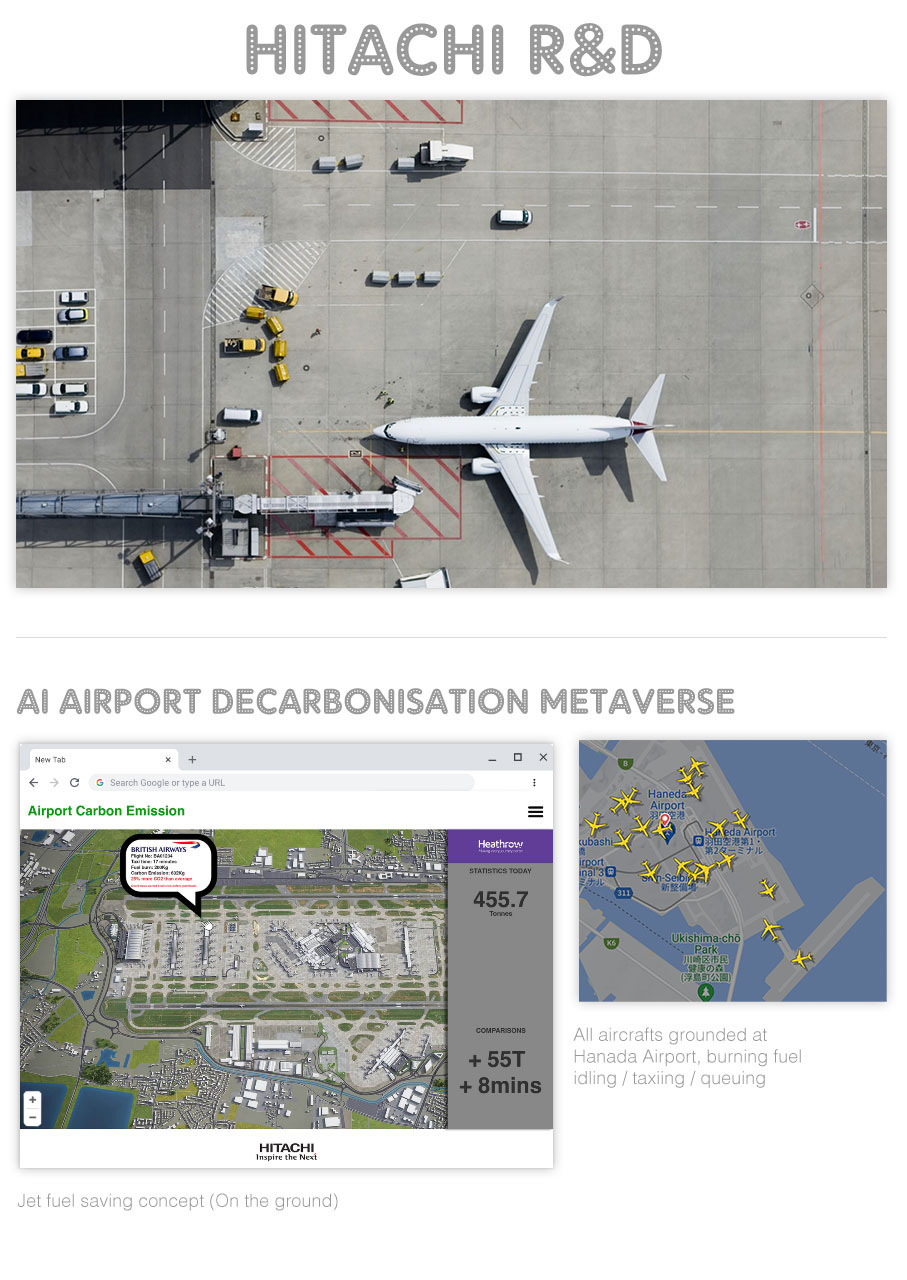
At Hitachi R&D, I developed a concept exploring how a digital model of the airfield could help predict potential disruption before it occurred, allowing pilots and ground crews to respond proactively.
The problem
Airfield operations involve many moving parts.
A disruption might mean an aircraft is unable to land as planned, a taxiway becomes congested or ground operations are not optimised.
By the time the disruption becomes obvious, people may already be committed to actions that are expensive or difficult to reverse.
For example, aircraft may already have their engines running while waiting to land, resulting in unnecessary fuel consumption and delays for passengers.
I explored a different approach:
What if the airport could anticipate operational problems before they happened?
From technology to opportunity
The concept used a metaverse / digital model of the airport and its operational data to explore how potential disruption could be predicted and communicated.
My role was not to develop the underlying predictive technology.
My role was to understand:
- What problem should the technology solve?
- Who needs to know?
- What information would they need?
- When would they need it?
- What action could they take?
- What value would that create?
This meant translating complex technical possibilities into a human and operational experience.
Designing for multiple users
The concept involved multiple stakeholders with very different needs.
For example:
Pilots need timely information that can influence decisions during an operational journey.
Ground crews need actionable information to coordinate activity on the airfield.
Airport operators need a broader view of the system and its potential disruption.
Rather than treating these as separate interfaces, I explored the wider service and information ecosystem connecting them.
My contribution
I personally developed the initial opportunity and product concept, then worked with technical specialists to explore how it could be realised.
I:
- Identified the operational problem and potential opportunity.
- Developed the future scenario.
- Explored the relationship between airport data and operational decision making.
- Created user journeys and scenarios.
- Developed the service proposition.
- Designed how predictive information could become actionable.
- Created prototypes and visual demonstrations.
- Worked with engineers and researchers to explore technical feasibility.
- Communicated the concept to stakeholders.
- Connected the experience to potential operational and commercial value.
Designing beyond the interface
This project is representative of how I worked in R&D.
The deliverable was not simply a dashboard.
The real design problem was the relationship between:
People + data + physical environment + technology + operational decisions + business value
That required thinking about the entire system and how people would interact with it in the real world.
The value proposition
The concept explored two connected opportunities:
Reduce unnecessary operational disruption
and
Reduce the knock-on impact on fuel consumption and passenger journeys.
The underlying idea was to move airport operations from reacting to disruption towards anticipating it.
What I brought to the project
I turned an emerging technology capability into a product and service opportunity.
The work demonstrates my ability to enter technically complex environments, understand the potential of the technology, identify a meaningful human and business problem, and create a tangible concept that engineers, researchers and business stakeholders can understand and develop.
Skills demonstrated
Product Discovery
Systems Thinking
Complex Product Design
Service Design
Emerging Technology
Data-driven Experiences
Future Scenario Design
User Journey Design
Rapid Prototyping
Technical Collaboration
Business Opportunity Development
Physical + Digital Experience Design