Biometric Single Sign On
Reimagining authentication with finger vein biometrics
What if authentication didn’t require a password, phone or physical ticket?
At Hitachi R&D, I worked with Hitachi’s finger vein biometric technology to explore how biometric authentication could create simpler, more seamless experiences across digital and physical environments.
My role was to help identify and define compelling use cases for the technology, explore the customer experience, support mobile authentication applications and test the technology in real world environments.
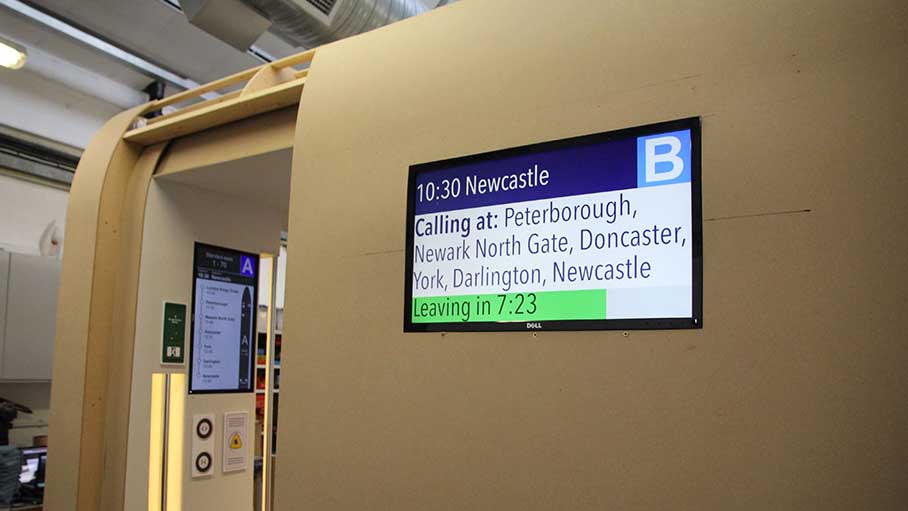
One of the most tangible trials involved installing biometric scanners at a railway station, allowing passengers to pass through station gates simply by presenting their hand.
The opportunity
Biometric technology can provide a powerful way to identify people, but the technology itself is only part of the solution.
The design challenge was to understand:
Where could biometric authentication genuinely improve the experience?
When would someone want to use it?
How should the experience work across different environments?
What happens before, during and after authentication?
I worked with technical specialists to understand the capabilities and limitations of Hitachi’s finger vein technology, then translated those capabilities into potential products, services and user experiences.
Identifying use cases
I helped explore and define potential use cases for biometric Single Sign On across both digital and physical environments.
This involved considering the complete journey rather than treating authentication as an isolated interaction.
For example:
Identity → authentication → access → service → transaction
The objective was to understand where removing passwords, cards or manual identification could create meaningful value for users and organisations.
I developed scenarios and user journeys to explore how biometric authentication could fit naturally into people’s existing behaviour, while considering the practical requirements of the technology and operating environment.
Supporting mobile authentication
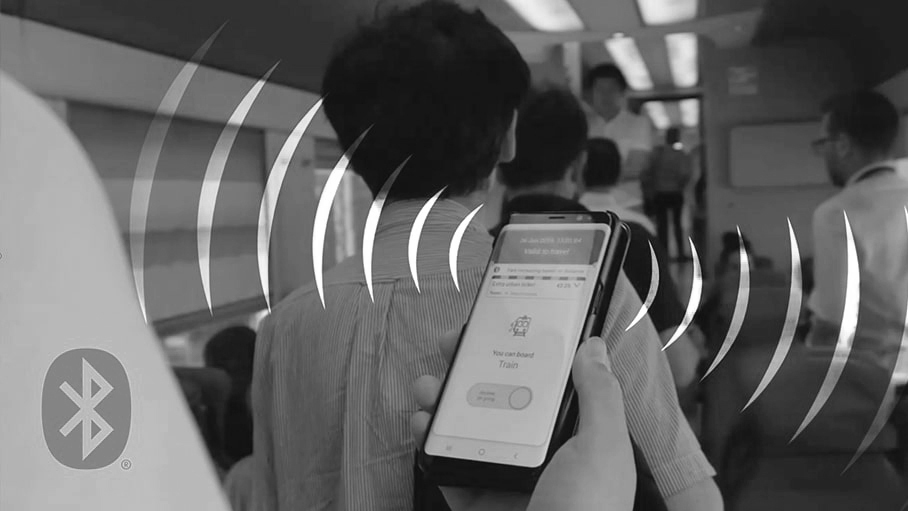
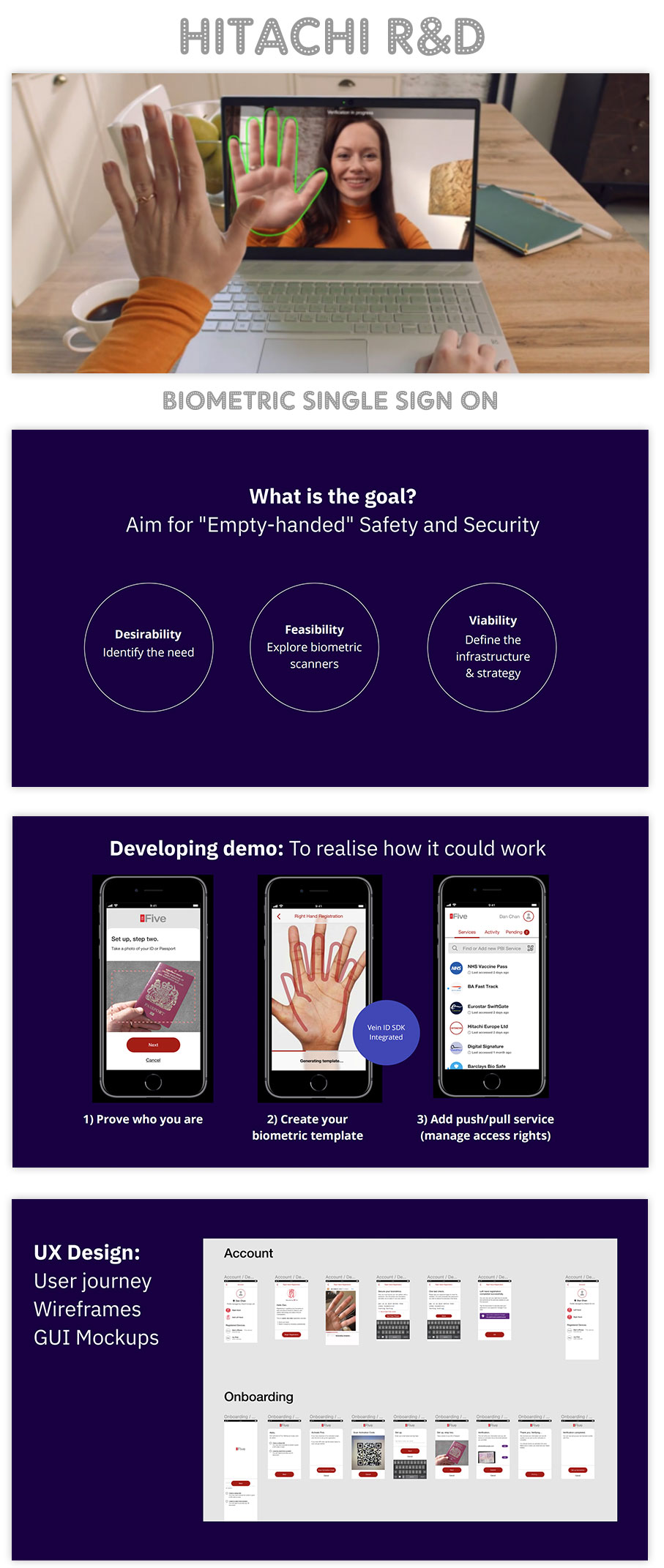
Alongside the physical trials, I supported the exploration of biometric authentication within mobile applications.
I worked on how the authentication experience could be introduced, understood and completed from a user’s perspective, translating the underlying biometric capability into a clear digital interaction.
This meant considering not only the successful authentication journey, but also the surrounding experience:
- How users understand what is happening
- How authentication is initiated
- What happens when authentication succeeds
- What happens when it fails
- How users recover from an unsuccessful attempt
- How biometric authentication connects with the wider service
The focus was on making sophisticated biometric technology feel simple from the user’s perspective.
Taking biometrics into the real world
One of the most valuable parts of the project was moving beyond digital prototypes and testing the technology in a physical environment.
I supported trials involving the installation of biometric scanners at railway stations, exploring how passengers could use their hand to authenticate and pass through station gates.
This introduced a very different set of UX considerations.
The experience had to work within an existing physical environment, alongside station infrastructure, passenger flows and the expectations people already have when entering a railway station.
I therefore considered the complete interaction:
Approach → recognise → present hand → authenticate → receive feedback → pass through gate
Rather than designing only the scanner interface, I considered the interaction between the passenger, biometric hardware, station environment and digital service.
Designing for technology that didn’t yet have an established pattern
Biometric authentication was an emerging technology and there was no established passenger experience to simply copy.
That meant I had to work from first principles.
I explored:
- What users would naturally expect to happen
- How people would understand the unfamiliar interaction
- Where instructions or feedback were needed
- How the physical interaction should work
- How authentication could connect to a wider service
- How the experience could work across mobile and physical environments
This was typical of my role within Hitachi R&D: starting with an emerging technical capability and asking what a useful, desirable and commercially viable experience could look like.
Working across disciplines
The project required close collaboration with technical specialists, researchers and other stakeholders.
My role was often to bridge the gap between the technical capability and the human experience.
I translated technical discussions into:
Use cases → user journeys → interaction concepts → prototypes → physical trials
I also helped communicate the concept through demonstrations and tangible experiences, allowing stakeholders to understand how the technology could work rather than discussing it only in abstract terms.
From emerging technology to experience
The project demonstrated an important principle in my R&D work:
The technology is not the product. The experience created around it is.
Finger vein authentication provided the technical capability. My role was to explore where that capability could solve a real problem, define the experience around it and help validate whether people could use it naturally in the real world.
The result was an exploration of authentication that extended beyond the screen, combining biometrics, mobile applications, physical infrastructure and human behaviour into a connected experience.
My contribution
I contributed across the early product discovery and experience design process, including:
Use Case Discovery
Identifying where biometric authentication could create meaningful value.
Product & Service Design
Defining how biometric authentication could become part of a wider customer journey.
UX Research
Exploring user expectations, behaviours and responses to an unfamiliar interaction.
Mobile UX
Supporting biometric authentication experiences within mobile applications.
Physical + Digital UX
Designing across mobile interfaces, biometric hardware and railway environments.
Prototyping & Demonstration
Making emerging technology tangible for stakeholders and users.
Real World Testing
Supporting physical trials with biometric scanners installed at railway stations.
Emerging Technology
Translating finger vein biometric technology into practical human experiences.
Cross-functional Collaboration
Working between technical specialists, researchers, business stakeholders and users.
The bigger picture
This project captures the type of work I carried out throughout Hitachi R&D.
I wasn’t given an established product and asked to make the interface look better.
I was brought into emerging technology projects early and asked to help answer a much harder question:
“What could people actually do with this?”
My contribution was to find the opportunity, understand the user, define the experience and make the technology tangible enough to test, challenge and develop.